

Worm Count Kits
Test your pets faeces for the presence of worm egs before spending out on or giving drugs to kill worms.
You can read more about my recommended parasite control on the website advice sections
Faecal Egg Count
Faecal Egg Count (FEC) is a method of determining how many internal parasite eggs are present in a particular dung sample. It may also be possible to determine the different types of worms or other parasites present.
If eggs are found in a faecal sample it shows that worms are present in the animal.and you should get a wormer for your pet.
“We always test our sample twice to ensure a professional accurate result”
This is the lab we use and you can read a lot more about intestinal and lungworms found in the UK on their pages.
The procedure is:
Buy a kit, collect a stool sample or samples, send it to the approved lab in the enclosed envelope and we get the results a few days later. Our vet will report back with a recommendation.
Read more about natural parasite control on these pages and why for environmental reasons as well as your pet’s health you should not over worm.
What do we test for?
Lungworm Kits
for Dogs and Cats
A kit to collect your pet’s poop to send to the lab to check for lung worm eggs
And then you will get results back and our Veterinary Surgeon will recommend treatment or not depending on the results
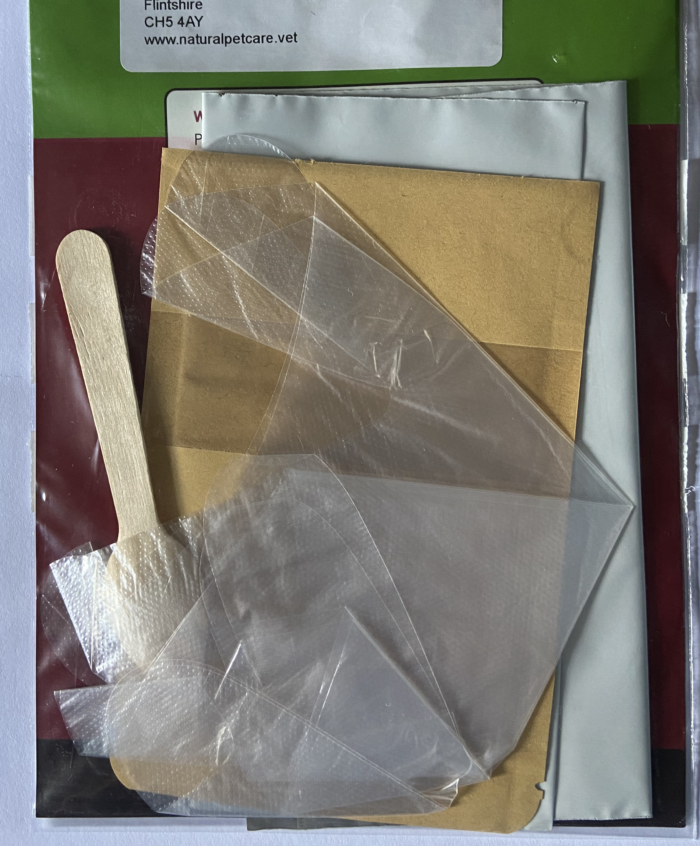
If you order you will receive a package with the equipment needed to collect a small faeces sample. You send it off the in envelope provided and our Vet gets the results back by email and we will forward it to you with professional recommendations.
In most cases you will find no worms and will not need to do any thing.
Postage and Lab testing included
Unlike intestinal parasites, lungworms reside in the lungs of a dog. Most dogs will not show any signs of having lungworms, but some can develop a cough. Snails and slugs are popular intermediate hosts of this type of parasite, but dogs are usually infected after eating a bird or rodent who has ingested an intermediate host.or drinking from streams or puddles.Lungworm
Our Lungworm faecal sample test is done using a technique called Baermann flotation , which may show larvae of both Angiostrongylus and Crenosoma but bear in mind that larvae may only be present intermittently in the faeces and dogs may show clinical signs such as coughing prior to the larvae being present in the faeces.
The faecal sample is suspended in a solution for 24 hours, Then analysed, Lungworm Faecal tests are not 100% , if you know of Lungworm cases in your area a veterinary blood test is advisable.
Dog Lungworm Analysis
- Oslerus osleri. (Canine Lungworm)
- Crenosoma vulpis, (Fox Lungworm)
- Filaroides Hirth (Canine Lungworm)
- Eucoleus aerophiles (Hedgehog Lungworm)
- Angiostrongylus Vasorum (French Heartworm)
Cat Lungworm Analysis
- Capillaria Aerophilus
- Aelurostrongylus Abstrusus
Please note:
A Fecal egg count is a snap shot of a specific moment in time. The test detects eggs of mature parasites that live inside the body and pass their eggs to the outside by shedding them into the dogs stool’s. It is possible that at the time of testing the parasites are too young to produce eggs, if no eggs are being shed the infection cannot be detected. There is also a possibility the eggs are In such small numbers at the time of testing they would be undetectable Thus showing a negative result.
The above is extremely rare but we would like to point out the possibilities.
Instructions for taking samples:
Worm (Green poo bag x 1)
Lungworm (Brown poo bags x 3) 3 samples taken over 3 days.
Puppy Pooled Litter worm Kit (Green poo bag x 3) 3 pooled samples taken over 3 days.
- Place the sample in the relevant poo bags
- Put the poo bag/s into the smaller compostable zip bag
- Place this into the larger compostable zip bag
- Complete your information leaflet
- Place both the leaflet and the larger compostable bag (which now contains your sample/s) into the postage bag.
Then contact us and we will recommend what to do.

Reviews
There are no reviews yet.